Showing posts with label Yugoslavia. Show all posts

Thursday, 29 July 2021

Dora Kosorčić, Damir Agičić (eds.): Klub studenata historije Sveučilišta SHS u Zagrebu – Zapisnici [Minutes of the Association of History Students of the University of SHS in Zagreb], Zagreb: Srednja Europa 2021.


URL: https://srednja-europa.hr/novosti/klub-studenata-historije-sveucilista-shs-u-zagrebu-zapisnici/

U knjizi su objavljeni transkribrirani zapisnici sjednica Kluba slušača historije, odnosno Kluba studenata historije koje je djelovalo na zagrebačkom Filozofskom fakultetu u međuratnom razdoblju. Zapisnici Kluba studenata historije, pohranjeni u Hrvatskom državnom arhivu u fondu “Klub studenata Historije Sveučilišta Srba, Hrvata i Slovenaca u Zagrebu” zapisnici su odborskih sjednica i glavnih skupština kluba u razdoblju od njegova osnivanja 1925. godine do prestanka rada 1941. godine. Ovi zapisnici predstavljaju vrijednu povijesnu građu, budući da pružaju uvid u organizaciju i unutarnji život jedne od većih i aktivnijih studentskih organizacija na zagrebačkom Filozofskom fakultetu u međuratnom razdoblju, ali omogućavaju i uvid u aspekte znanstvenog, političkog, društvenog i kulturnog života i svakodnevice studenata u međuratnom razdoblju. Uz to, ovi su zapisnici vrijedan izvor i za povijest hrvatske historiografije; u radu kluba, kao njegovi mentori i savjetnici studenata, predavači ili voditelji stručnih ekskurzija, aktivno su sudjelovali istaknuti hrvatski povjesničari: Ferdo Šišić, Grga Novak, Milan Prelog, Ljudmil Hauptmann i drugi. (Klub studenata historije Sveučilišta Srba, Hrvata i Slovenaca u Zagrebu, Dora Kosorčić)


Zapisnike su prepisali studenti Lucija Bakšić, Ivan Grkeš, Josip Humjan, Lea Kasabašić, Nenad Jurilj, Robert Korenić, Andrijana Petrina i Sven Španić. Redigirala ih je doktorandica Dora Kosorčić a konačno pregledao i uredio profesor Damir Agičić.

Monday, 26 July 2021

Heike Karge: Der Charme der Schizophrenie. Psychiatrie, Krieg und Gesellschaft im kroatisch-serbischen Raum [The Charm of Schizophrenia: Psychiatry, War, and Society in the Croato-Serbian Region]. Oldenbourg: De Gruyter 2021. ISBN: 9783110738926


(Deutsch unten)

About this book

This long-term study (1870 to 1950) asks how mental illness was diagnosed, interpreted, and experienced in the Croato-Serbian region during times of war and peace, and places the answers in their specific cultural, institutional and societal contexts. The "age of anxiety" arrived late and was dominated by the diagnosis of "schizophrenia." One surprising reason for this was the dominance of patients coming from rural areas.


Author information

Heike Karge, Institute of History, University of Regensburg, Germany.

---------

Über dieses Buch

Wie psychisches Kranksein im kroatisch-serbischen Raum diagnostiziert, gedeutet und erfahren wurde, wird in dieser Langzeitstudie (für 1870 bis 1950) in kulturelle, institutionelle und gesellschaftliche Zusammenhänge gestellt.


Den untersuchten Raum kann man laut Heike Karge für diese Zeit als schizophren bezeichnen. Die Krankenakten offenbaren nämlich, dass dortige Patienten kaum als neurotisch, hysterisch oder nervös, sondern vornehmlich eben als schizophren eingeordnet wurden. Anders als im deutschen, russisch-sowjetischen und US-amerikanischen Bereich wurden dort auch für Soldaten beider Weltkriege kaum je Diagnosen gestellt, die spezifisch an den Krieg angebunden waren. Gesellschafts- und wissenschaftsgeschichtlich bedeutsam ist, dass eine wesentliche Ursache für das späte Aufkommen des „nervösen Zeitalters" im südslawischen Bereich in einem Fremdheitsempfinden des urbanen Fachpersonals gegenüber den mehrheitlich vom Lande stammenden Patienten begründet lag.


Autoreninformation

Heike Karge, Institut für Geschichte, Universität Regensburg, Deutschland.

Wednesday, 24 March 2021

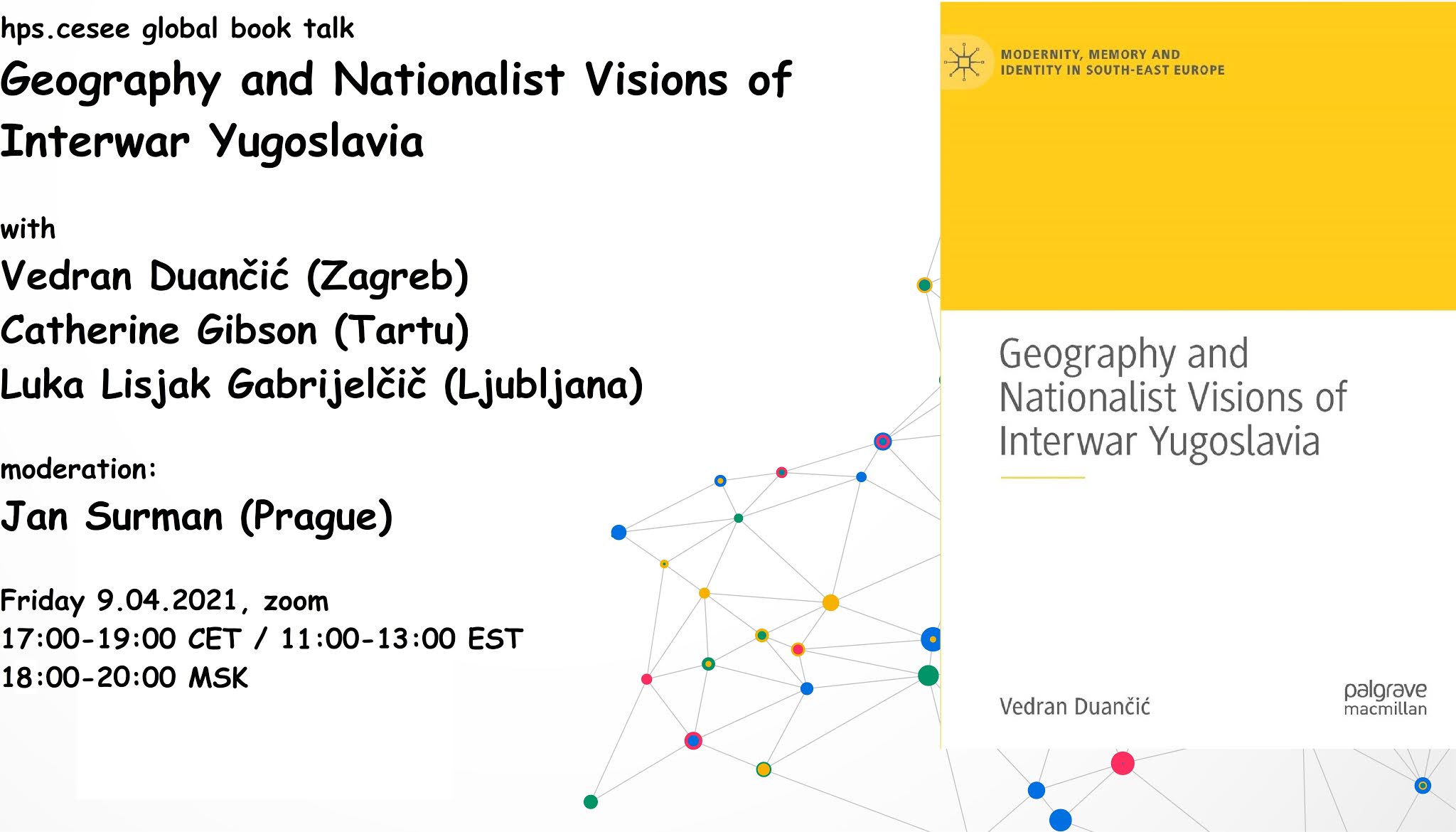
hps.cesee book talk: Catherine Gibson,Luka Gabrijelčič & Vedran Duančić on Geography and Nationalist Visions of Interwar Yugoslavia, Friday, April 9, 17:00-19:00 Central European Time (CET) / 18:00-20:00 MSK/ 11:00-13:00 EST


The virtual platform HPS.CESEE (History of Science in Central, Eastern, and Southeastern Europe) is proud to present its forthcoming book talk. Catherine Gibson (University of Tartu) and Luka Lisjak Gabrijelčič (Ljubljana) will join Vedran Duančić (Zagreb) to comment on his recent book, Geography and Nationalist Visions of Interwar Yugoslavia (Basingstoke: Palgrave Macmillan 2020), in a discussion moderated by Jan Surman.

"Geography and Nationalist Visions of Interwar Yugoslavia "is the first historical work to examine the notion of national territories in Yugoslavia – a concept fundamental for the understanding of Yugoslav history. Exploring the intertwined histories of geography as an emerging discipline in the South Slavic lands and geographical works describing interwar Yugoslavia, the book focuses on the engagement of geographers in the on-going political conflict over the national question. Duančić shows that geographers were uniquely equipped to address the creation of the new country and the numerous problems it faced, as they provided accounts of Yugoslavia’s past, present, and even future, all of which were understood as inherently embedded in geography. By analyzing a large body of geographical narratives on the Yugoslav state, the book follows both the attempts to “naturalize” and present Yugoslavia as a sustainable political and cultural unit, as well as the attempts to challenge its existence by pointing to unresolvable, geographically conditioned tensions within it. The book approaches geographical discourse in Yugoslavia as part of a wider European scientific network, pointing to similarities and specifically Yugoslav characteristics."

The meeting is free and open to the public. To receive the link, please register here: http://tiny.cc/hpsceseeDuancic or write to hps.cesee@gmail.com.

Vedran Duančić is a Postdoctoral Researcher in the Institute for the History and Philosophy of Science at the Croatian Academy of Sciences and Arts. Geography and Nationalist Visions of Interwar Yugoslavia is a reworked version of PhD dissertation defended at European University Institute in 2016.

Catherine Gibson is historian of the Russian Empire, currently research fellow at the University of Tartu. In 2019 she received PhD from European University Institute with dissertation on imperial geography in the 19th century.

Luka Lisjak Gabrijelčič is a historian, essayist and translator, currently PhD candidate at the program in Comparative History of Central, Southeastern and Eastern Europe at the Central European University, Budapest. He is an editor at Slovenian cultural quarterly Razpotja.


Monday, 14 December 2020

East Central Europe Volume 47 (2020): Issue 2-3 (Nov 2020): Thematic Issue: Staged Otherness. Ethnographic Shows in Central and Eastern Europe, 1850–1939 edited by Dagnosław Demski, Dominika Czarnecka and Kamila Baraniecka-Olszewska


URL: https://brill.com/view/journals/eceu/47/2-3/eceu.47.issue-2-3.xml

Table of Contents

Contextualizing Ethnographic Shows in Central and Eastern Europe; Authors: Dominika Czarnecka and Dagnosław Demski, pp. 163–172

Relocating the “Human Zoo”: Exotic Displays, Metropolitan Identity, and Ethnographic Knowledge in Late Nineteenth-Century Budapest; Author: László Kontler, pp.173–201

Spaces of Modernity: Ethnic Shows in Poznań, 1879–1914; Author: Dagnosław Demski, pp. 202–232

“The Samoans Are Here!”: Samoan Ethnic Shows, 1895–1911; Author: Hilke Thode-Arora, pp. 233–260

Others among Others: Latvians’ View of Members of Ethnographic Shows; Author: Ilze Boldāne-Zeļenkova, pp. 261–284

Black Female Bodies and the “White” View: The Dahomey Amazon Shows in Poland at the End of the Nineteenth Century; Author: Dominika Czarnecka, pp. 285–312

Buffalo Bill and Patriotism: Criticism of the Wild West Show in the Polish-Language Press in Austrian Galicia in 1906; Author: Kamila Baraniecka-Olszewska, pp. 313–333

The Modernity of Interwar Turkey through the Eyes of Yugoslav Travelers (1923–1939); Author: Anđelko Vlašić, pp. 335–359

Debate on Europe since 1989 by Philipp Ther, pp. 361–394

On Diana Mishkova; pp. 395–409

Contents; pp. 411–413

Monday, 23 November 2020

Sima M. Ćirković: Živeti sa istorijom [Living with history]. Tekstove odabrao i priredio Vlastimir Đokić. Beograd, 2020. ISBN-978-86-7208-217-3


URL: 

OPEN ACCESS: https://www.helsinki.org.rs/serbian/doc/Svedocanstva%2041.pdf

Knjiga Živeti sa istorijom sačinjena je od 63 kraća teksta Sime Ćirkovića, koji se “žanrovski” mogu odrediti kao naučni ogledi, novinski eseji, razgovori, intervjui. Nastali su najvećim delom, mada ima i ranijih i kasnijih, u vremenskom periodu 1985–1995, vremenu od početka ubrzanja razvoja krize integriteta jugoslovenskog kulturnog i političkog prostora, njenog rasta i kulminacije u vidu raspada zajedničke države, građanskog rata i svakovrsnih neprijateljstava između naroda i narodnosti na tlu nekadašnje države i njenih posleratnih produžetaka. Iako specijalista za proučavanje udaljene i završene istorijske epohe – tzv. srednjeg veka na Balkanu – Sima Ćirković smatrao je za svoju dužnost da u okolnostima narastajuće društvene krize deluje u pravcu širenja istorijske kulture i proširivanja tolerancije. Tako je nastalo oko stotinak njegovih tekstova, čiju većinu okuplja ova knjiga. Njeno objavljivanje pored kulturnog ima stoga i poseban društveni značaj, s obzirom na to da skoro nijedan od problema u regionu koje je u ovim tekstovima tretirao do danas nije prevladan. Jedan broj ovde zastupljenih tekstova – prevashodno oni u poglavlju naslovljenom “Problemi istoriografije” – snažno osvetljava stanje i kretanja u srpskoj i jugoslovenskoj istoriografiji i poziciju Sime Ćirkovića u njima. Jedan manji deo knjige priređivač je posvetio i samoj ličnosti autora tako što je odabrao Ćirkovićeve tekstove u kojima govori o svom životnom putu, pedagoškoj i naučnoj karijeri, svojim glavnim delima i svojim uzorima. Može se reći da knjiga u celini, ali naročito njen drugi deo, ima karakter intelektualnog i moralnog autoportreta jednog od najznačajnijih srpskih istoričara druge polovine XX veka. Porukama koje sadrži ona može snažno uticati na buduće generacije istoričara. S verom u to, predajem je čitaocima kao znak zahvalnosti i poštovanja prema autoru. 

V. Đokić

Thursday, 15 October 2020

Środowisko studenckie w krajach bloku sowieckiego 1945–1990 [The Student Milieu in the Soviet Bloc Countries 1945–1990], red. Kamil Dworaczek i Krzysztof Łagojda, Wrocław–Warszawa: IPN 2020, 664 s., ISBN druk 978-83-8098-991-7

URL: https://ipn.gov.pl/pl/publikacje/ksiazki/106841,Srodowisko-studenckie-w-krajach-bloku-sowieckiego-19451990.html

Spis tresci: http://tiny.cc/6f0zsz
Prezentowany tom stanowi pokłosie międzynarodowej konferencji „Środowisko studenckie w krajach bloku sowieckiego 1945–1989” zorganizowanej w dniach 29 XI – 1 XII 2016 r. we Wrocławiu. Powyższa problematyka spotkała się z olbrzymim zainteresowaniem badaczy z całego świata, na konferencję nadesłano blisko 80 zgłoszeń. Ostatecznie wzięło w niej udział 58 naukowców z 19 krajów, m.in. Polski, Rosji, Stanów Zjednoczonych, Białorusi, Albanii, Wielkiej Brytanii, Bułgarii i Serbii. Tak zróżnicowana reprezentacja prelegentów dała sposobność spojrzenia na wiele zagadnień badawczych z perspektywy różnych krajów. W naszym zamyśle było odnalezienie wspólnych zjawisk obecnych w ruchach studenckich w Europie Środkowo-Wschodniej, choć w równym stopniu zależało nam na uchwyceniu specyfiki społeczności studenckiej w poszczególnych państwach. Warto podkreślić niedostatek tego rodzaju badań komparatystycznych, i to nie tylko w odniesieniu do środowiska studenckiego. Mamy nadzieję, że konferencja i niniejsza książka choć w niewielkim stopniu przyczynią się do wypełnienia tej luki.

Thursday, 17 September 2020

Thesis Eleven, Issue 159, August 2020 Eastern European Marxist Critical Theory

URL: https://thesiseleven.com/2020/08/29/issue-159-august-2020-eastern-european-marxist-critical-theory/

EASTERN EUROPEAN MARXIST CRITICAL THEORY

This special issue features papers delivered at the 2018 International Conference on Marxist Critical Theory in Eastern Europe (Sichuan University, Chengdu). The conference included Agnes Heller as guest of honour alongside renowned international and Chinese scholars. The event was sponsored by the College of Literature and Journalism, Sichuan University and Key Project of China National Social Science Fund “The Research of Eastern Europe Marxist Aesthetics” and co-sponsored by Thesis Eleven.
Guest editor: Professor Fu Qilin (Sichuan University)

INTRODUCTION:

MODERNITY, PRAXIS AND THE WORK OF ART: CONTEMPORARY THEMES IN EASTERN EUROPEAN CRITICAL THEORY

J.F. Dorahy

ARTICLES:

GEORG LUKÁCS AND LEO TOLSTOY

Agnes Heller, Deng Fengming

ON THINKING: OPEN LETTER TO HANNAH ARENDT

Agnes Heller, David Roberts, Peter Beilharz

SIX THEORETICAL PARADIGMS OF EASTERN EUROPEAN MARXIST AESTHETICS

Fu Qilin

REVISITING LUKÁCS’ THEORY OF REALISM

Galin Tihanov

AT THE CROSSROADS OF MARXISM AND STRUCTURALISM IN MODERN POLISH LITERARY THEORY (1918–1939): THE CASE OF WARSAW AND VILNIUS STUDENT CIRCLES

Danuta Ulicka

MARXIST CRITICISM OF SOVIET-TYPE SOCIETY IN CZECHOSLOVAKIA: THE POLITICAL THOUGHT OF EGON BONDY AFTER 1968

Petr Kužel

ART AS PRAXIS: DANKO GRLIĆ’S CONCEPTION OF ART BEYOND TECHNOLOGICAL DETERMINISM

Marko Hočevar

BAUMAN IN CHINA

Qin Jiayang, Peter Beilharz

LAST BAUMAN/LOST BAUMAN: FIFTY YEARS ON – SKETCHES IN THE THEORY OF CULTURE (1968) – THE SUPPRESSED AND NOW FINAL BOOK OF ZYGMUNT BAUMAN (2018)

Peter Beilharz

BOOK REVIEWS:

SOCIAL THEORY NOW

Rachel Busbridge (A prepublication version of this review is freely available here)

MULTICULTURAL POLITICS OF RECOGNITION AND POSTCOLONIAL CITIZENSHIP

Nicolas Pirsoul (A prepublication version of this review is freely available here)

COUNTERREVOLUTION: THE GLOBAL RISE OF THE FAR RIGHT

Erwin Rafael

FOUCAULT: THE BIRTH OF POWER

Peter Beilharz

FOUCAULT’S LAST DECADE

Mitchell Dean

Monday, 7 September 2020

Vedran Duančić, Geography and Nationalist Visions of Interwar Yugoslavia. London: Palgrave Macmillan 2020. eBook ISBN978-3-030-50259-1; Hardcover ISBN978-3-030-50258-4.


  • Examines the notion of national territories in Yugoslavia
  • Explores the intertwined histories of geography as an emerging discipline in the South Slavic lands
  • Approaches geographical discourse in Yugoslavia as part of a wider European scientific network

This book is the first historical work to examine the notion of national territories in Yugoslavia – a concept fundamental for the understanding of Yugoslav history. Exploring the intertwined histories of geography as an emerging discipline in the South Slavic lands and geographical works describing interwar Yugoslavia, the book focuses on the engagement of geographers in the on-going political conflict over the national question. Duančić shows that geographers were uniquely equipped to address the creation of the new country and the numerous problems it faced, as they provided accounts of Yugoslavia’s past, present, and even future, all of which were understood as inherently embedded in geography. By analyzing a large body of geographical narratives on the Yugoslav state, the book follows both the attempts to “naturalize” and present Yugoslavia as a sustainable political and cultural unit, as well as the attempts to challenge its existence by pointing to unresolvable, geographically conditioned tensions within it. The book approaches geographical discourse in Yugoslavia as part of a wider European scientific network, pointing to similarities and specifically Yugoslav characteristics.

Vedran Duančić is a Postdoctoral Researcher in the Institute for the History and Philosophy of Science at the Croatian Academy of Sciences and Arts.

Thursday, 27 August 2020

John Lampe, Constantin Iordachi (eds.): Battling over the Balkans: Historiographical Questions and Controversies. Budapest etc.: CEU Press 2020. ISBN: 978-963-386-325-1


URL: http://ceupress.com/book/battling-over-balkans

The tumultuous history of the Balkans has been subject to a plethora of conflicting interpretations, both local and external. In an attempt to help overcome the stereotypes that still pervade Balkan history, Battling over the Balkans concentrates on a set of five principal controversies from the precommunist period with which the region’s history and historiography must contend: (1) the pre-1914 Ottoman and Eastern Christian Orthodox legacies; (2) the post-1918 struggles for state-building; (3) the range of European economic and cultural influence across the interwar period, as opposed to diplomatic or political intervention; (4) the role of violence and paramilitary forces in challenging the interwar political regimes in the region; and (5) the fate of ethnic minorities into and after World War II, particularly Jews, Muslims and Roma.
In an attempt to give a voice to eminent local authors, the chapters provide samples of new regional scholarship exploring these contested issues—most of them translated into English for the first time—and are prefaced with historiographical overviews addressing the state of the debate on these specific controversies. These translations help bridge the language barriers that often separate scholarly traditions within Southeast Europe, as well as scholars in Southeast Europe and English-speaking academia. It is hoped that the volume will enable readers to identify common patterns and influences that characterize the writing of history in the region, and will stimulate new transnational and comparative approaches to the history of the Balkans.

Thursday, 7 May 2020

CALL FOR PAPERS FOR A THEMATIC ISSUE OF FACTA UNIVERSITATIS: SOCIALIST MEDIA CULTURE FROM SOCIOLOGICAL PERSPECTIVE

We hereby invite all interested colleagues to submit research papers, review articles, discussion papers, and thematic essays for the thematic issue of the journal Facta Universitatis: Philosophy, Sociology, Psychology and History, Vol. 19, No 2, 2020.

This Call for Papers is aimed at bringing together a selected number of scholars and associates from the academic community who wish to participate in the project titled “SOCIALIST MEDIA CULTURE FROM SOCIOLOGICAL PERSPECTIVE”.
In the "short” 20th century or in "era of extremes", as Hobsbawm (1994) called the century we left behind, many dramatic changes and transformations occurred in almost all areas of social, economic, political and cultural life in Europe and the world. We had two World Wars and many other inter-ethnic conflicts and confrontations. In 1989 Europe witnessed the fall of the Berlin Wall and the tumultuous breakdown of communism in Eastern European and Central European countries. In many ways, this year is seen as a historical turn. During the 90s, Yugoslavia, a well-known European country ceased to exist as a state. Communism and socialism, in many ways and many spheres, have marked the 20th century. For term communism in public discourse, we often use socialism, although in the literature about Marxism we found communism as one of the types of socialism. Also, there are scientific and news articles that make differences between communist and capitalist countries. When we talk about Yugoslavia, we talk about soft socialism.
It is necessary to focus on the research field of everyday life and popular culture in the former socialist countries, as well as their influence on later cultural phenomena, audience reception and the formation of post-socialist identities. The call for papers aims to: determine the context of the emergence of socialist media culture; identify how socialist media culture, as a part of the culture, represents everyday life and social reality; explain whether the media culture that belongs to all social groups can transform different social practices; evaluate how post-socialist audiences redefine preferred social meanings.
You are kindly invited to submit the final versions of your research paper (in electronic format) by June 30, 2020.
The research papers should be submitted in English, and it should not exceed 16 pages (A4 format, max. 40.000 characters with spaces, line spacing 1.5, font Times New Roman, font size 12).
The submitted papers will be subject to double-blind peer review. In order to ensure the authenticity, relevance and legibility, the submitted papers are also subject to the process of proof-reading and copy-editing by the editors and editorial staff.
For technical details and editorial requirements on preparing the paper for publication, please refer to Author Guidelines, available at
http://casopisi.junis.ni.ac.rs/index.php/FUPhilSocPsyHist/about/submissions#authorGuidelines
Editors of the thematic issue: Assist. prof. Natasha Simeunović Bajić (University of Niš), Assoc. prof. Vyara Angelova (Sofia University St Kliment Ohridski) and Assoc. prof. Romina Surugiu (University of Bucharest).
Niš, February 14, 2020
ISSN 1820-8495 (Print)
ISSN 1820-8509 (Online)

Thursday, 16 April 2020

Płotka, Witold, Eldridge, Patrick (Eds.) Early Phenomenology in Central and Eastern Europe: Main Figures, Ideas, and Problems. Cham: Springer International Publishing 2020. eBook ISBN 978-3-030-39623-7; Hardcover ISBN 978-3-030-39622-0; DOI10.1007/978-3-030-39623-7


This book presents the origins of Central and Eastern European phenomenology. It features chapters that explore the movement's development, its most important thinkers, and its theoretical and historical context. This collection examines such topics as the realism-idealism controversy, the status of descriptive psychology, the question of the phenomenological method, and the problem of the world.
The chapters span the first decades of the development of phenomenology in Czechoslovakia, Poland, Romania, Russia, and Yugoslavia before World War II. The contributors track the Brentanian heritage of the development. They show how this tradition inspired influential thinkers like Celms, Špet, Ingarden, Frank, Twardowski, Patočka, and others. The book also puts forward original investigations. Moreover it elaborates new accounts of the foundations of phenomenology. While the volume begins with the Brentanian heritage, it situates phenomenology in a dialogue with other important schools of thought of that time, including the Prague School and Lvov-Warsaw School of Logic.
This collection highlights thinkers whose writings have had only a limited reception outside their home countries due to political and historical circumstances. It will help readers gain a better understanding of how the phenomenological movement developed beyond its start in Germany. Readers will also come to see how the phenomenological method resonated in different countries and led to new philosophical developments in ontology, epistemology, psychology, philosophy of culture, and philosophy of religion.

TABLE OF CONTENTS

  • Płotka, Witold (et al.): Introduction: Rediscovering Early Phenomenology in Central and Eastern Europe, 1-15
  • Janoušek, Hynek (et al.): Early Phenomenology in Prague, 17-34
  • Łukasiewicz, Dariusz: Husserl’s Early Phenomenology and the Ontology of Truth in the Lvov-Warsaw School, 35-57
  • Artemenko, Natalia: Gustav Špet’s “Hermeneutical Phenomenology” Project: His Reinterpretation of Husserl’s Phenomenology, 59-74
  • Kozin, Alexander: On the Phenomenological Implications of Semyon Frank’s Psychological Philosophy of the Living Soul, 75-91
  • Jonkus, Dalius: Vasily Sesemann’s Theory of Knowledge, and Its Phenomenological Relevance, 93-110
  • Piwowarczyk, Marek: Roman Ingarden’s Early Theory of the Object, 111-126
  • Cernica, Viorel: Nae Ionescu and the Origins of Phenomenology in Romania, 127-144
  • Vēgners, Uldis: Theodor Celms and the “Realism–Idealism” Controversy, 145-162
  • Płotka, Witold: Leopold Blaustein’s Descriptive Psychology and Aesthetics in Light of His Criticism of Husser, 163-185
  • Novotný, Karel: Life and the Natural World in the Early Work of Jan Patočka (1930–1945), 187-202
  • Prole, Dragan: The Beginnings of Phenomenology in Yugoslavia: Zagorka Mićić on Husserl’s Method, 203-216
Witold Płotka, Dr. habil., is Associate Professor at the Institute of Philosophy at the Cardinal Stefan Wyszynski University in Warsaw. He was a visiting researcher at the Husserl-Archiv of the University of Cologne. His publications include articles on, for instance, the theory of intentionality, theory of knowledge, and the history of the phenomenological movement. He published two books: Studia z fenomenologii poznania. Transcendentalna filozofia Edmunda Husserla a problem wiedzy [Studies in the Phenomenology of Cognition. Transcendental Philosophy of Edmund Husserl and the Problem of Knowledge] (2015) and Fenomenologia jako filozofia mniejsza. Rozważania wokół sporów o metodę Husserla [Phenomenology as a Minor Philosophy. Considering the Controversies over Husserl’s Method] (2019). He edited also two-volumes of Wprowadzenie do fenomenologii [Introduction to Phenomenology] (2014), and co-edited (together with Peter Andras Varga) the Special Issue of the Horizon. Studies in Phenomenology (5(1), 2016) dedicated to phenomenology in Central and Eastern Europe. He is the winner of “The 2011 CARP Directors’ Memorial Prize in Honour of José Huertas-Jourda.” He is member of the Husserl Circle, former Secretary of the Polish Phenomenological Association, and President of the Central and East European Society for Phenomenology (CEESP). Recently he published, for instance, “Reduction and the Question of Beginnings in Husserl, Fink and Patočka” (Human Studies, 41(4), 2018), “From Psychology to Phenomenology (and Back Again): A Controversy over the Method in the School of Twardowski” (Phenomenology and the Cognitive Sciences, Online First, 2019), and “A Controversy over the Existence of Fictional Objects: Husserl and Ingarden on Imagination and Fiction” (Journal of the British Society for Phenomenology, 51(1), 2020).
Patrick Eldridge, PhD, is Assistant Professor in the Department of Humanities and Languages at the University of New Brunswick in Saint John. He obtained his doctorate at the Husserl Archives (KU Leuven) and was a visiting doctoral researcher at the University of Oregon. His research areas include Phenomenology, Philosophy of Memory, and Post-Kantian European Philosophy. He is the author of the articles: “Depicting and Seeing-in. The ‘Sujet’ in Husserl’s Phenomenology of Images,” Phenomenology and the Cognitive Sciences 17 no.3 (2018): 555-573; “Regret and the Consciousness of the Past,” International Journal of Philosophical Studies 25 no.5 (2017): 646-663; “The Punctum and the Past. Sartre and Barthes on Memory and Fascination,” Sartre Studies International 22 no.1 (2016): 117-131; “Observer Memories and Phenomenology,” Phenomenology & Mind 7 (2015): 213-223. He has translated numerous works from French and German into English, including works by Rudolf Bernet, Jan Assmann and (together with Nicolas de Warren) the correspondence between Krzysztof Michalski and Jan Patočka.

Monday, 13 April 2020

Andrija Štampar: Travel Diary 1931–1938. Edited by Željko Dugac and Marko Pećina. Translated by Boris Blažina. Zagreb: Croatian Academy of Sciences and Arts–Andrija Štampar School of Public Health, School of Medicine, University of Zagreb–Srednja Europa, 2020.

A prominent Croatian physician and an expert working for international health organisations, Dr Andrija Štampar, wrote this Diary during his travels around the world between 1931 and 1938. He met various kinds of people—presidents, minsters, diplomats, and famous professors and scientists. He witnessed the Italian occupation of Abyssinia, the Sino-Japanese War, Soviet Five-Year Plans, and the rise of dictatorships in Europe. In the Diary, he also described the fate of ordinary people, primarily peasants, in the whirlwind of war, poverty, illness, and personal tragedies. Štampar's personal life also unravels on the pages of the Diary alongside the life of his family back home.


Thursday, 9 April 2020

Ruža Fotiadis, Vladimir Ivanović and Radina Vučetić (eds.): Brotherhood and Unity at the Kitchen Table: Food in Socialist Yugoslavia. Zagreb: Srednja Europa 2019. ISBN 9789538281112


An illuminative way to approach the history of Yugoslav society is to look into the kitchens and cooking pots and to ask which dishes and beverages typically appeared on the table on a daily basis. This book, entitled Brotherhood and Unity at the Kitchen Table: Food Culture in So - cialist Yugoslavia, does precisely that. [... ] The contributions in this volume convey an impres - sion of what might have constituted “Yugoslav” commonalities “at the kitchen table” and also exemplify what kind of “common sociality” in the eating culture might have transcended all kinds of political or societal “cleavages” that have increasingly become the main or only focus in many studies about “political Yugoslavia”. Prof. Hannes Grandits
Prijatno! Dobar tek! Пријатно! Пријатно јадење! Të bëftë mire! Bon appétit! Enjoy your meal! Guten Appetit!

Ruža Fotiadis, post-doctoral researcher and lecturer at the Chair for South-East European History at Humboldt University Berlin
Vladimir Ivanović, associate post-doctoral re - searcher at the Chair for South-East European History at Humboldt University Berlin
Radina Vučetić, professor of Contemporary History at the Department of History, Faculty of Philosophy, University of Belgrade

Thursday, 26 March 2020

Duančić, Vedran. Lysenko in Yugoslavia, 1945–1950s: How to De-Stalinize Stalinist Science.

Duančić, Vedran. Lysenko in Yugoslavia, 1945–1950s: How to De-Stalinize Stalinist  Science. Journal of the History of Biology (2020), https://doi.org/10.1007/s10739-020-09598-2

Abstract:
By the summer of 1948, socialist Yugoslavia seemed determined to follow in the footsteps of its closest ally, the Soviet Union, and strike a decisive blow to “reactionary genetics.” But barely a month before the infamous VASKhNIL session, the Soviet–Yugoslav split began to unravel, influencing the reception of Lysenko’s doctrine in Yugoslavia. Instead of simply dismissing it as yet another example of Stalinist deviationism, Yugoslav mičurinci carefully weighed its political and ideological implications, trying to negotiate the Stalinist origins of Michurinist biology with political and ideological reconfigurations in post-Stalinist Yugoslavia. The essay examines the strategies employed by supporters and opponents of Lysenko’s doctrine, as well as those sympathetic to it but yet unconvinced of its scientific validity and political appropriateness. It emphasizes globally unique attempts to de-Stalinize Michurinist biology and use it in the political-ideological struggle against the Stalinist Soviet Union, pointing to local agency and the bottom-up nature of attempts both in support of and against the doctrine.

Keywords:
Lysenkoism, Michurinist biology, Genetics, Marxism, Yugoslavia, Tito–Stalin Split

Thursday, 5 March 2020

Johannes Feichtinger, Anil Bhatti, Cornelia Hülmbauer (eds.): How to Write the Global History of Knowledge-Making: Interaction, Circulation and the Transgression of Cultural Difference. Cham: Springer 2020, https://doi.org/10.1007/978-3-030-37922-3

Introduction
This multidisciplinary collection of essays provides a critical and comprehensive understanding of how knowledge has been made, moved and used, by whom and for what purpose. To explain how new knowledge emerges, this volume offers a two-fold conceptual move: challenging both the premise of insurmountable differences between confined, autarkic cultures and the linear, nation-centered approach to the spread of immutable stocks of knowledge. Rather, the conceptual focus of the book is on the circulation, amalgamation and reconfiguration of locally shaped bodies of knowledge on a broader, global scale. The authors emphasize that  the histories of interaction have been made less transparent through the study of cultural representations thus distorting the view of how knowledge is actually produced.
Leading scholars from a range of fields, including history, philosophy, social anthropology and comparative culture research, have contributed chapters which cover the period from the early modern age to the present day and investigate settings in Africa, Asia, and Europe. Their particular focus is on areas that have largely been neglected until now. In this work, readers from many disciplines will find new approaches to writing the global history of knowledge-making, especially historians, scholars of the history and philosophy of science, and those in culture studies.

Table of Contents

Johannes Feichtinger: Introduction: Interaction, Circulation and the Transgression of Cultural Differences in the History of Knowledge-Making, 1-26

KNOWLEDGE PRODUCTION BEYOND THE LOGIC OF CULTURAL DIFFERENCE

Peter Burke, The Role of Exiles in the History of Knowledge: Two Cases, 29-44
Johann Heiss, Johannes Feichtinger, Interactive Knowledge-Making: How and Why Nineteenth-Century Austrian Scientific Travelers in Asia and Africa Overcame Cultural Differences, 45-69

MOBILIZATIONS OF KNOWLEDGE RECONSIDERED

Jan Surman, How Romance Studies Shaped the Ukrainian Language and How the Ukrainian-Romanian Conflict Helped to Create Ladinian: A (Very) Entangled History of A-Political Science, 73-90
Dragan Prole, A Spiritual Unity of Europe and the Yugoslav Politics of Knowledge in the Interwar Period: A Philosophical Enhancement of the ‘Slavic Spirit’, 91-103

SHIFTING POSITIONS OF AND FOR KNOWLEDGE PRODUCTION

Dhruv Raina, A History of Circulation vs. an ‘Episodic’ History of Mathematics in South Asia: Titrating the Historiography and Social Theory of Science and Mathematics, 107-127
Manolis Patiniotis, Shaping Newtonianism: The Intersection of Knowledge Claims in Eighteenth-Century Greek Intellectual Life, 129-148

WRITING A SHARED HISTORY OF KNOWLEDGE PRODUCTION

Kris Manjapra, Queer Diasporic Practice of a Muslim Traveler: Syed Mujtaba Ali’s Chacha Kahini, 151-166
Marcus Twellmann, Shared Village Stories: How (Not) to Disentangle Literary Historiography from ‘Modernization’, 167-183
Ulrike Kistner, Can Black Folk Dream—in Theory? Psychoanalysis and/of/in Coloniality—Anamnesis of a Failed Encounter, 185-200
Franz Leander Fillafer, Positivist Worldmakers: John Stuart Mill’s and Auguste Comte’s Rival Universalisms at the Zenith of Empire, 201-218
Anil Bhatti, Afterword, 219-226


Call for chapter proposals: Polish Science Fiction: Literature, Film, and Cultural Legacy

 Call for chapter proposals: Polish Science Fiction: Literature, Film, and Cultural Legacy deadline for submissions:  October 15, 2026 full ...